Showing posts with label plants. Show all posts
Nepenthes Flower - Plants of this Nepenthes plants bag is an ornamental plant that is quite unique and exotic. This unique shape makes nepenthes plants look more attractive for the ornamental planting flowers in the yard of our home. But unfortunately this nepenthes ornamental plant species can only be found in certain places.

Villagers are generally not familiar with the term nepenthes plant, they mostly only know the term Nepenthes plants bag. This type of ornamental plant is quite popular Nepenthes plants among the community, both among lower class society or upper class society.

Nepenthes plants flower has a very wide spread from the beach to the highlands, because this is nepenthes divided into two types of highland and lowland species, although most species grow in the highlands. The recorded species grew at the highest altitude was N. lamii ie at an altitude of 3.520 m.

Type of Nepenthes Flowers

Here are some types of Nepenthes plants bag plants, which look amazing and seductive, but who would have thought this enchanting plant is a great predator.

1. Nepenthes Madagascariensis
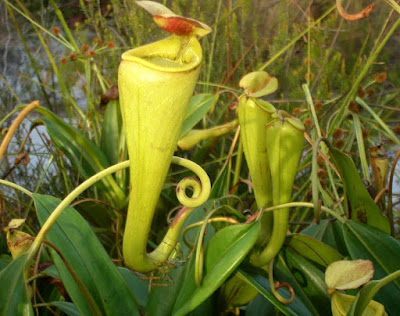
Nepenthes Madagascariensis

Nepenthes madagascariensis is one of two species of Nepenthes plants pockets found on Madagascar Island, its habitat is on the east of the island.

2. Nepenthes Jacquelineae
Nepenthes Jacquelineae

Nepenthes jacquelineae is a sumatra endemic bag of Sumatran, and is one of the most spectacular Nepenthes plants bags on the island.

3. Nepenthes Appendiculata
Nepenthes Appendiculata

Nepenthes appendiculata is the only known tropical plant of the middle Saraose Hose Mountains, Borneo, growing at an altitude of 1450-1700 m Meters above sea level. This species is characterized by the addition of an enlarged gland on the lower surface of the lid, and is named appendiculata

4. Nepenthes Aristolochioides
Nepenthes Aristolochioides

The place where this plant grows at an altitude of 1800-2500 m above sea level. This kind of Nepenthes plants-type flower has a very strange shape than in general, with an almost vertical opening in the trap bag.

This plant was first collected by Willem Meijer on August 5, 1956. The holotype, Meijer 6542, was collected from Gunung Tujuh in Jambi at an altitude of 2000 m.

5. Nepenthes Jamban
Nepenthes Jamban

The Nepenthes plants Jamban bag is one of the most endangered species of Nepenthes plants bag (Nepenthes) that is endemic to North Sumatra.

The name of this species is taken from the Indonesian language which refers to the form of a pouch that resembles a toilet or toilet. The species was first collected on April 22, 2005 from southern Padang Sidempuan.

6. Nepenthes Villosa
Nepenthes Villosa

This Nepenthes plants bag is located in Mount Kinabalu and Mount Tambuyukon on Borneo Island

7. Nepenthes Ceciliae
Nepenthes Ceciliae

Nepenthes ceciliae is a Nepenthes species that has not yet been described by its taxon. This is a Filipino endemic species located on the island of Mindanao, it lives at an altitude of 1500-1800 m above sea level. His discovery was announced on the internet in August 2011.

8. Nepenthes Rajah
Nepenthes Rajah

Nepenthes Rajah is also an endemic plant in Mount Kinabalu and Mount Tambuyukon on the island of Borneo. It belongs to an endangered species.

9. Nepenthes Maxima
Nepenthes Maxima

Nepenthes maxima grows in Sulawesi Island, Maluku Islands, and Papua Island

10. Nepenthes Ampullaria
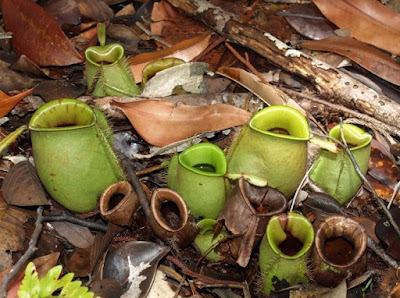
Nepenthes Ampullaria

The above Nepenthes is a Sumatran endemic sac plant that lives at altitudes between 2400 to 2900 m above sea level. No varieties of N. above have been found. The use of the above species name is derived from the Indonesian language "above".

In fact, it violates the preposition rule in Bahasa Indonesia, but demands in the use of binomial nomenclature which requires only two names, namely the genus and species names, so that the words "di" and "above" are forced to be combined.

11. Nepenthes Truncata
Nepenthes Truncata

Named so because its leaf-like shape is truncated.Nepenthes truncata is one of the Nepenthes plants bag species which is an endemic carnivorous plant on the island of Mindanao in the Philippines.

This type of Nepenthes plants bag grows at an altitude between 0-1500 m. This plant was once encountered trapping rats.

12. Nepenthes Khasiana
Nepenthes Khasiana

Nepenthes Khasiana Is the only Nepenthes plants bag species originating from India.

13. Nepenthes Rafflesiana
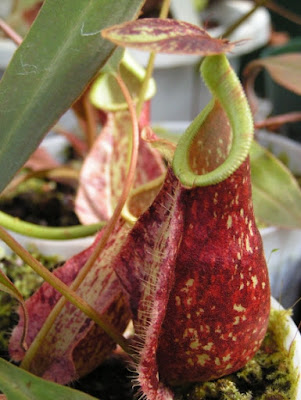
Nepenthes Rafflesiana

Pocket Nepenthes plants Rafflesia Has a wide spread area, including Borneo, Sumatra, Peninsular Malaysia, and Singapore. Nepenthes rafflesiana has many variations (second after Nepenthes mirabilis) with some of them already found.

In Borneo alone, at least four different varieties have been found. Its giant form alone can rival the species of Nepenthes rajah in size.

14. Nepenthes Dragon
Nepenthes Dragon

Dragon Nepenthes plants Bag is a plant of semi-endemic bag Bukit Barisan, Sumatra. The unique shape that distinguishes this type of Nepenthes plants flower is apparently similar to the body of a bottle and an organ that is shaped like a snake tongue that comes out from the bottom of the pouch cover.

The name of the dragon is taken from the Indonesian language which refers to the shape of the cover of the sac and external body and its large size. This name also refers to folklore in Bukit Barisan which is touted as a dragon habitat in the past.

15. Nepenthes Pitopangii
Nepenthes Pitopangii

Nepenthes pitopangii is endemic on the island of Sulawesi. Nepenthes pitopangii was discovered in 2006 with the discovery of a specia in Lore Lindu National Park.

16. Nepenthes Termostato
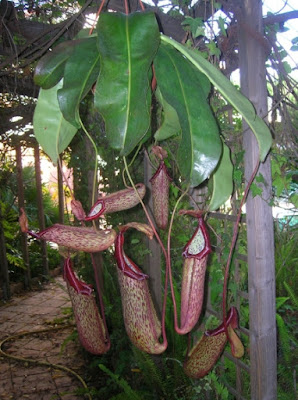
Nepenthes Termostato

This species is the most distinctive of the genus Nepenthes, can be found in Borneo, Sumatra, Thailand, Peninsular Malaysia, Singapore, Maluku Islands, and New Guinea. Nepenthes ampullaria is also known to be the only "vegetarian" Nepenthes plants baggage species, due to the pockets of this type of Nepenthes plants bag.

It does not have a nectar gland on the pouch lips so rarely do the insects get stuck in the bag. Generally most of the objects found in the bag are rotting leaves, animal dung, small branches and rain water.

How, interested in planting this ornamental plant of this flower? guaranteed insects that move in your house will be reduced drastically.

So little discussion of the 16 Species of Ornamental PlantsNepenthes Flowers hopefully with this restriction can add insight and knowledge to all of us, thank you very much for visiting.

Read also other articles:
Dahlia Flowers - Is a bulbous shrub that is annual, flowering in summer until autumn. Dahlia flowers also become the national flower of the Mexican country which is also the country of origin of this flower.

Dahlia is an ornamental flower plant in the form of an upright annual plant. This plant comes from the mountains of Mexico. Dahlia flowers include cultivated ornamental plants.

In Europe cultivation began in 1789, from the Royal Botanical Garden in Madrid, Spain and spread to all Western Europe.

Although the development was very slow, in 1841 there were 1,200 varieties. Dahlia flowers imported to West Java from the Netherlands during the colonial period in the 19th century. Now This plant is an important commodity flower / pot flower in some parts of the world.

This plant includes flowers that are late to breed. In 1872, the Netherlands received a box of Dahlia bulbs sent from Mexico. From a box of Dahlia flower bulbs it turns out just one bulb that managed to bloom but produces a beautiful flower red color with a pointed leaf.

Plant experts managed to breed Dahlia flowers later called Dahlia juarezii. Dahlia juarezii is the ancestor of all the hybrid Dahlia flowers (crosses) contained today.

Benefits of Dahlias Flowers

Cactus dahlia flowers are white color is always soldbelikan because it is a type of flower that is widely used to arrange the flowers of grief. Another color rich Dahlia is sold inside polybags for use as an outdoor plant.

Dahlia is a plant berubi. Sweet potato contains almost 70 per cent starch proportions in inulin form. Pure inulin extraction from sweet potato dahlia used in the field of medicine.

When inulin is fermented by a particular enzyme or by a soil fungus, inulin will turn into fructose, a sugar widely used in food preservation or syrup production. Therefore, the utilization of inulin from dahlia flowers through bioconversion into fructose sugar.

3 How to Plant Dahlias Flowers

How to Plant Dahlias Flowers With Seeds

This method is done on mini dahlia to get new and more varied flower color. Seed comes from a healthy 5-month-old dahlia plant. Seeds are sown directly on prepared nurseries.
Nursery media is made on the ground with width of 1 m and long depending on the land with the North-South direction. The media is made from a mixture of humus, cow manure and fertile soil with a ratio of 1: 1: 1.

Media Height 5 cm. Seedlings spread evenly over the medium and covered with a thin layer of soil. In the dry season Media is covered with banana leaves that have been washed or sack of clean jute so that moisture Media awake.

The media needs to be given shade if the seedbed is done in the rainy season. The shade is a transparent plastic as high as 80 cm in the east and 60 cm on the west side. After the seeds germinated and leafed two strands, the cover (banana leaves / burlap sacks) was opened.

Seedlings are kept in a nursery to a perfect leaf of 2 pieces, in this stadium the roots of the plant have not touched the base of the Media and transferred to transparent polybag 18 × 15 cm containing mixture of husk and cow manure (6: 1).

After the 6-leafed plant, the second plant is moved into transparent polybag 30 × 20 cm containing the same media. Inside this polybag the plants are kept until flowering for 1.5-2 months and ready for sale.

How to Plant Dahlias Flowers With Steak

This method is done on mini dahlia to get flowers with the same color and shape and for large seeds that can not be seed. Cut material taken from axillary buds of 7-10 cm in size. To avoid disease, use a clean cutting knife / knife to cut the buds. The nursery is carried out in a transparent 30 × 20 cm polybag containing mixture of rice husk and manure (6: 1 comparison) and kept until ready to sell without being transferred for 3 days.

How to Plant Dahlias Flowers From Tubers

This method is done on cactus and semi cactus dahlia. Sweet potatoes are taken from a 7 month old plant. To get the tubers, stems of plants that have expired the first flowering period cut to 10 cm from the surface of the soil. The soil is excavated and sweet potato is lifted along with the main stem.

How to Take Care Dahlis Flower

  • Plants in the nursery: As long as the seedbed nursery once a day and not given the fertilizer because the food has been quite a lot obtained from the media. Weed weeding should be done very carefully so as not to damage the seeds that are still easily damaged.
  • Plants in the polybag: Plants watered 1-2 days (morning-afternoon) except when it rains. Weeds rarely grow, if there are weeding removed or taken with a small hoe To prevent pests / diseases, plants sprayed with antracol pesticides / Basudin 2 weeks at the turn of the dry season and rainy season. Gandasil leaf fertilizer and 1 gram of NPK are given once a week.
  • Thinning and Replanting is done to get a uniform growth can be done until the plants are 3 weeks old. In general, the seeds do not grow perfectly when watering late done especially if the hot air. Flower thinning needs to be done especially if the number of flowers in one stalk is too much for the diameter of the flowers to reach the maximum. In cactus dahlia (white) only one flower left to live on one stalk, while in semi-cactus dahlias can be 5-6 flowers.
  • Weeding is done in accordance with the growth of weeds and at the time of fertilization and pembumbunan. Prevention of weed growth can be done by spreading organic mulch among the plants. When the plant reaches 1 m, plants are grown and supported with 2 bamboo sticks so as not to fall down.
  • Fertilization is done every 10 days with urea, SP-36 and KCl each 2 gram or NPK as much as 5 gram. Giving first 10 days after planting move. Fertilizer is given in the strip as far as 15 cm from the base of the stem. Cover fertilizer with soil.
  • Watering and watering: Performed according to plant growth. At the beginning of its growth, the soil around the base of the stem to the point of the outer canopy should not dry out. At that time, if necessary the plant watered 2-3 times a day depending on weather conditions. After that watering can be done every 5 days. Watering also needs to be done after fertilizer application.


So little discussion of the 3 Ways to Plant and Take Care Dahlia Flowers and Benefits hopefully with this restriction can add insight and knowledge to all of us, thank you very much for visiting.

Read also other articles:
Saffron Flowers - Saffron flower is originally from the Crocus Sativus flower which in Arabic is called Za'faran, and the Malays call it kuma kuma. Saffron Crocus often gets the nickname of Vegetable Gold, Gold of Dessert, Spice King, Spice Queen, and many other nicknames for this flower plant. 

Each Crocus flower has three stigma heads or so-called stigmas. The part of the pistil stalk, the stalk that connects between the pistil and the inside of this flower is called Saffron Crocus. Before packed or used the stem is generally dried first.

Saffron Crocus is common in the Middle East and some European countries close to the Middle East, such as India, Iran, Kashmir (India-Pakistan border valley), Greece, Italy and Spain.

Saffron Flower Specialty
The Benefits of Saffron Flowers Plants

This flower can be said Special because Physical interest, this flower including flowers that have a beautiful appearance and pleasing to the eye. Benefit of interest, this flower is included which has many benefits for human life.

Therefore Saffron Crocus flower herbs are so expensive and much sought after by many people because these flowers are a lot of benefits and it has become common knowledge. Having a beauty that does not belong to another interest is one of the advantages again, the interest is interesting and also characterizes a strong characteristic of this Saffron Crocus flower.

One more thing that makes Saffron Crocus factor is expensive because it comes from the pistil sticks, because the number of pistils on the flowers just a little then this plant became one of the most expensive herbs in the world. In one flower, only have 3 pistils only.

Benefits of Saffron Crocus Flower

There are at least 3 Benefits of Saffron Crocus flowers for human life, namely:

1. Benefits of Saffron Crocus Flower For Food Ingredients

Saffron Crocus is an ingredient that is often used in food as a spice. The most commonly encountered is the use of Saffron Crocus on Briyani Rice, a typical Indian food. The yellow color that appears on the original Briyani Rice is not derived from turmeric, but from Saffron Crocus.

Saffron Crocus also gives a special taste on the Briyani Rice that gives characteristic. More and more use of Saffron Crocus on food will give a darker color. With too much content will provide a bitter taste in food.

If you are curious as to what flavor of this most expensive spice? Saffron has a slightly bitter taste on the tongue and the aroma is legit. Therefore planting it will probably be much more effective. In addition to save expenses, also can feel how it feels to keep the ornamental plants that fall into the category of the most expensive plants in the world. Of course it will be very nice and proud.

2. Benefits of Saffron Crocus Flowers For Health.

Saffron Crocus has many anticarcinogenic substances that function to prevent cancer, Antioxidants that prevents free radicals, and Antimutagenik which serves to prevent gene mutation.

Saffron Crocus contains a variety of nutrients such as fiber, protein, vitamin A (carotene), B, and C, selenium, potassium, magnesium, zinc, sodium, phosphorus and folic acid.

Saffron Crocus has properties that can prevent neurological diseases such as Parkinson's and Alzheimer's. other benefits of maintaining the function of organs in the body, maintaining fluid flow and blood pressure and cholesterol, raising stamina, treating constipation, raising eye health, increasing fertility hormones, treating depression, reducing the risk of heart disease, menstruation, and increase the ability to remember.

3. Benefits of Saffron Crocus Flowers As Perfumes.

Saffron Crocus has a unique flora and natural flora, which can provide peace of mind and can make people who kiss the fragrance becomes more relaxed. People in the Middle East have long used Saffron Crocus into their blend of fragrances. It is said that people who are having a headache when they smell the fragrance of Saffron Crocus can be pain relieved.

Price of Saffron Crocus Flower

Looking at the many benefits of Saffron Crocus, why not use Saffron Crocus in our daily needs? Can be really and highly recommended. But it takes a lot of money if we want Saffron Crocus into our monthly shopping list.

How much is per-Kg Saffron Crocus? The price of 1 kg of Saffron Crocus is about 690 - 830$. Why so expensive? Because in a flower stalk Crocus Sativus only produce 3 stalks Saffron Crocus, and that too must still be selected quality.

And that produces Saffron Crocus in large numbers in the world only some countries in the Middle East and some European countries close to the Middle East mentioned above earlier.

So nih, if there is a product, whether it is medicine, food, or fragrant oil that one of the womb is Saffron Crocus, mandatory and worth trying. When again there is an opportunity to try products filled by one of the most expensive raw materials in the world.

Certainly the product also provides a distinctive taste, color, and smell, which is not found in other products that do not use Saffron Crocus.

So little discussion of the The Benefits of Saffron Flowers Plants hopefully with this restriction can add insight and knowledge to all of us, thank you very much for visiting.

Read also other articles: 

Cambodian Flowers - At first the ornamental plants Cambidoan  flowers or Frangipani Flower are often considered haunted because many found in the cemetery.

But now this plant has been popular as an ornamental plant. Cambodian flower is not from frangipani, but comes from south america. How to Plant frangipani flowers can be done with several methods such as stem cuttings, grafts, seeds, grafting, and can instead be planted in pots.

Cambodian flowers found by a lover of a French crop called Charles Plumier, that's why Cambodian flowers has a Latin name Plumeria, different from flower frangipani japan which has name latin Adenium.

Since when its existence in Indonesia until now not known exactly. However, Cambodian flowers is predicted to be first brought to Indonesia by the Portuguese and the Dutch where both are a nation that concerns the environment and is very fond of the tropics. But how to grow frangipani flowers that once rotted much like now.

Predicted native Cambodian frangipani flower is white with a yellow inner, with a bud that is not fully open and small. Cambodian flower thrives in the lowlands up to a height of 700 meters, but in general this ornamental flower plants can flourish throughout the place.

How to Plant Cambodian Flowers

Frangipani flower has 2 leaf shape. The first one has a pointed leaf and the other has a rounded tip. The difference does not affect the way it is planted.

Better before buying specify first type, shape, color, and function of frangipani when will be planted later.

Make sure this frangipani tree has a root ball wrapped by sack / polybag. Fill a good polybag between 100 to 200 liters.

Before planting make a hole size 120 x 120 cm with a depth of 80 to 100 cm. Make sure the holes that have been dug there is no dirt like concrete, gravel, and so forth.

Planting frangipani with containers that are still attached. This is intended so that frangipani trees can adapt slowly to the growing media and the most recent place.

Frangipani flowers can we multiply in many ways, but now we are just going to discuss two ways to grow frangipani flowers, that is by cuttings on the stem of the plant and using the grafting technique.

In ancient times this frangipani flower on the land with grave flowers, when in Java and surrounding areas, this type of frangipani flowers grow wild in the burial area.

How to Plant Cambodian Flowers with Stek Rest

  • First, look for frangipani mothers who are big, old and healthy, have no defects. When you have met, then cut the frangipani rod with a length of approximately 20 cm. Leave it alone for a week, then place it in a shady place and not dry.
  • For the upper trunk, if you have a lot of dauj, just throw away the daunya, leave only 2 leaves. This is to reduce the evaporation of plants when we do the tapping.
  • After cutting, do not forget to immediately slice or smear the scar from the cut with a root stimulant that we can buy at the farm shop. This is so quick to stimulate the tumbunya roots.
  • For the planting medium, we can use the fuel husk we mix with charcoal, with a ratio of 1: 2. Then stir until evenly distributed.
  • After a week, the plants we have cut have been planted in a pot with the plant media as described above.
  • After we do the cutting stems, you should let it just once a week, not directly planted. This is to keep the emergence of bacteria and the shape of the tip that has not been smooth that can bring mushrooms and cendawa. After the stems in the plant, then do watering sufficiently, 3 times a day. It is not recommended to contain lots of water other than to prevent stem decay, this is also so that the process of root formation more quickly.

HOW TO PLANTS CAMBODIAN FLOWERS WITH OKULATION

  • First look for healthy plants, have big stems and grab the buds by cutting with a sharp knife.
  • Find the bottom stem we want to stick the buds, then slice just like with the slice of bud eye to fit when pasting.
  • Then attach the bud eye to the rootstock with the position of the bud eye facing upwards.
  • Next strap tightly, wear a plastic rope, remember when doing binding, bud eye should not be closed.
  • If it is ready, we should cut the rootstock of this plant just to accelerate the growth of the bud eye.
  • Put the plant in a shady and dry place and have a smooth air circulation.
  •  Keep in mind, many people yag upside down when doing the attachment of buds. Thus, the buds will not grow. Should be meticulous before attaching the eyes of the shoot so that when doing grafting in accordance with the desired kamboja.

HOW TO INTEREST CAMBODIAN FLOWERS

Cambodian is not a difficult tree in terms of treatment. Low maintenance should be carried by this type of tree. This flora character can be said to be resilient. This plant does not require too much human intervention since planted until it reaches a height of 4-5 meters.

We recommend that this tree is planted with the intensity of direct sunlight. The leaves are also not easy to fall out, just old flowers will certainly fall by itself. It also requires a porous planting media type.

Frangipani tree, although theoretically a lowland plant, it can grow fertile anywhere. Although easy to maintain, this tree also has problems with pest attacks.

So little discussion of the How to Plants Cambodian Flowers and Treatments hopefully with this restriction can add insight and knowledge to all of us, thank you very much for visiting.

Read also other articles:
 
Twitter Facebook Dribbble Tumblr Last FM Flickr Behance